
Construction & Building Finance
Construction Loan Process NZ: Progress Payments & Drawdowns
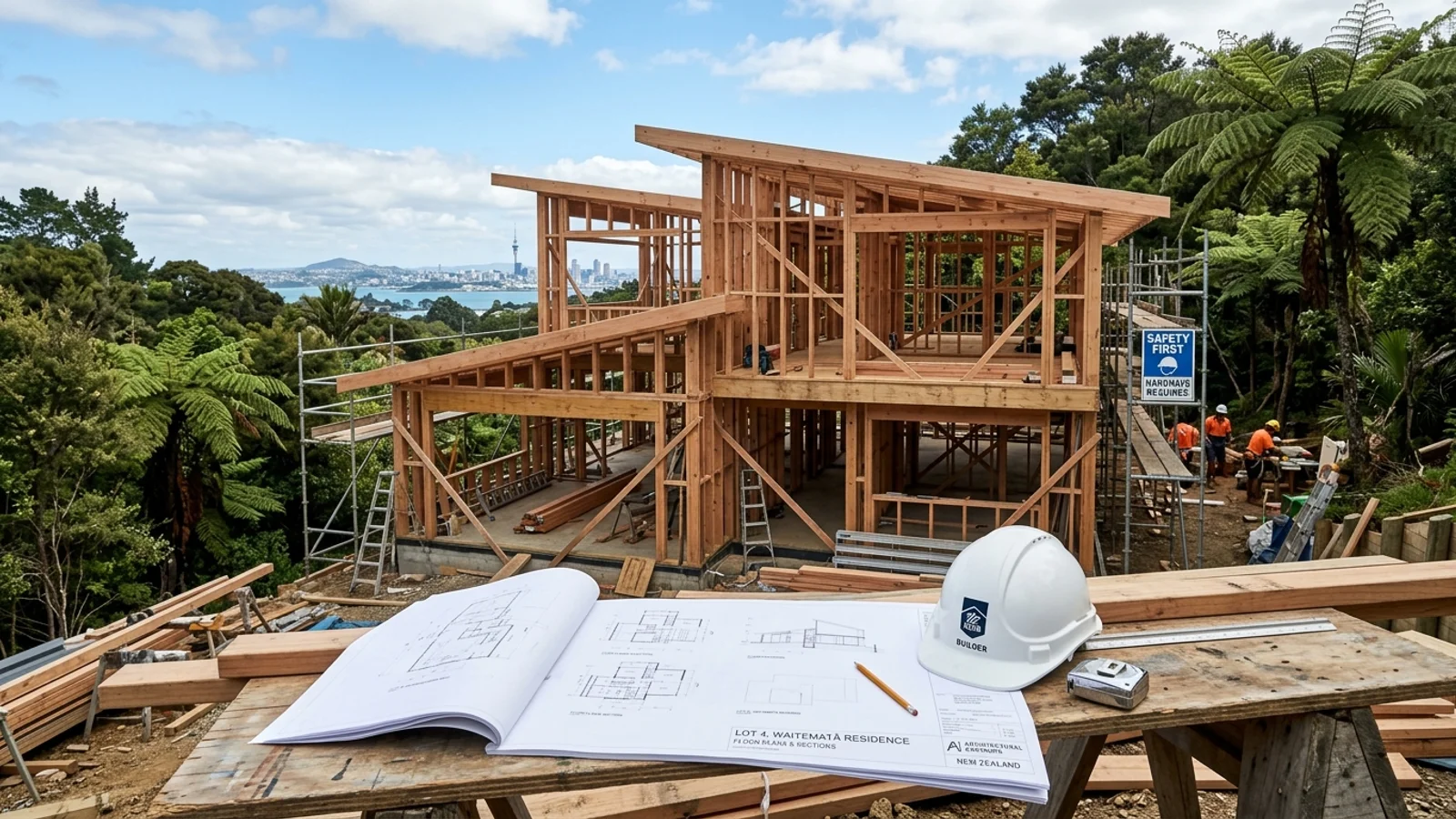
Building a new home in New Zealand is exciting right up until your builder hands you the first foundation invoice and your bank asks for three separate valuation certificates — that is when you realise blueprints are easy, but managing construction drawdowns is where the real heavy lifting happens.
The straight answer: the construction loan process in NZ is a staged funding facility where your bank releases money in progress instalments (drawdowns) as each physical milestone of your build is completed, inspected, and verified.
Unlike buying an existing home where a single settlement cheque changes hands on moving day, a construction mortgage runs on a dynamic timeline. You settle the land first, pay interest-only on drawn funds during construction, navigate council inspections, and convert the facility into a standard principal and interest home loan once the final Code Compliance Certificate (CCC) is issued.
Here is the complete step-by-step breakdown of how New Zealand building loans work, what lenders expect at every milestone, and how to structure your drawdowns so your project stays funded from foundation to handover.
How Does a Construction Loan Work in NZ?
When you purchase an existing property, your bank advances the full purchase amount on settlement day. With a new residential build, handing over $500,000 to a builder before a single timber stud is erected would expose both you and the bank to unacceptable project risk.
A construction loan operates as a progressive drawdown facility. The total loan is approved in full at the start, but funds remain locked in the lender's facility until specific, agreed building stages are reached.
Construction loans live or die on drawdown structuring, not the headline rate. A facility that doesn't match the build schedule creates cashflow gaps no rate discount fixes.
If your builder's contract demands 25% on framing, but your bank's policy caps the framing drawdown at 15% without a registered valuer sign-off, the build grinds to a halt while trades wait to get paid. Structuring the alignment between your builder's Master Build or Certified Builders contract and the bank's drawdown schedule before signing is the single most critical step in the entire process.
Turnkey Contract vs Progress Payment Build: Key Differences
When financing a new home in New Zealand, you will typically choose between two contractual structures: a turnkey contract or a staged progress-payment build.
Both options create brand new housing stock, but they require completely different mortgage arrangements:
| Feature | Turnkey Contract | Progress Payment Build |
|---|---|---|
| Deposit Requirement | 5% to 10% on signing | 15% to 20% on land + build total |
| Funding Timing | 100% at completion upon CCC | 5 staged drawdowns throughout construction |
| Interest During Build | Zero interest during construction | Interest-only on progressively drawn funds |
| Customisation Level | Fixed developer specifications | High flexibility in layout, fittings & materials |
| Land Ownership | Developer owns land until settlement | You own and settle the section first |
If you prefer a fixed package where the developer absorbs the construction cash flow, read our guide on buying a turnkey property. If you are buying a section and commissioning your own build, read on for the progress payment framework.
The 5 Standard Construction Drawdown Stages
In New Zealand residential lending, banks typically structure progress payments across five standardized construction milestones:
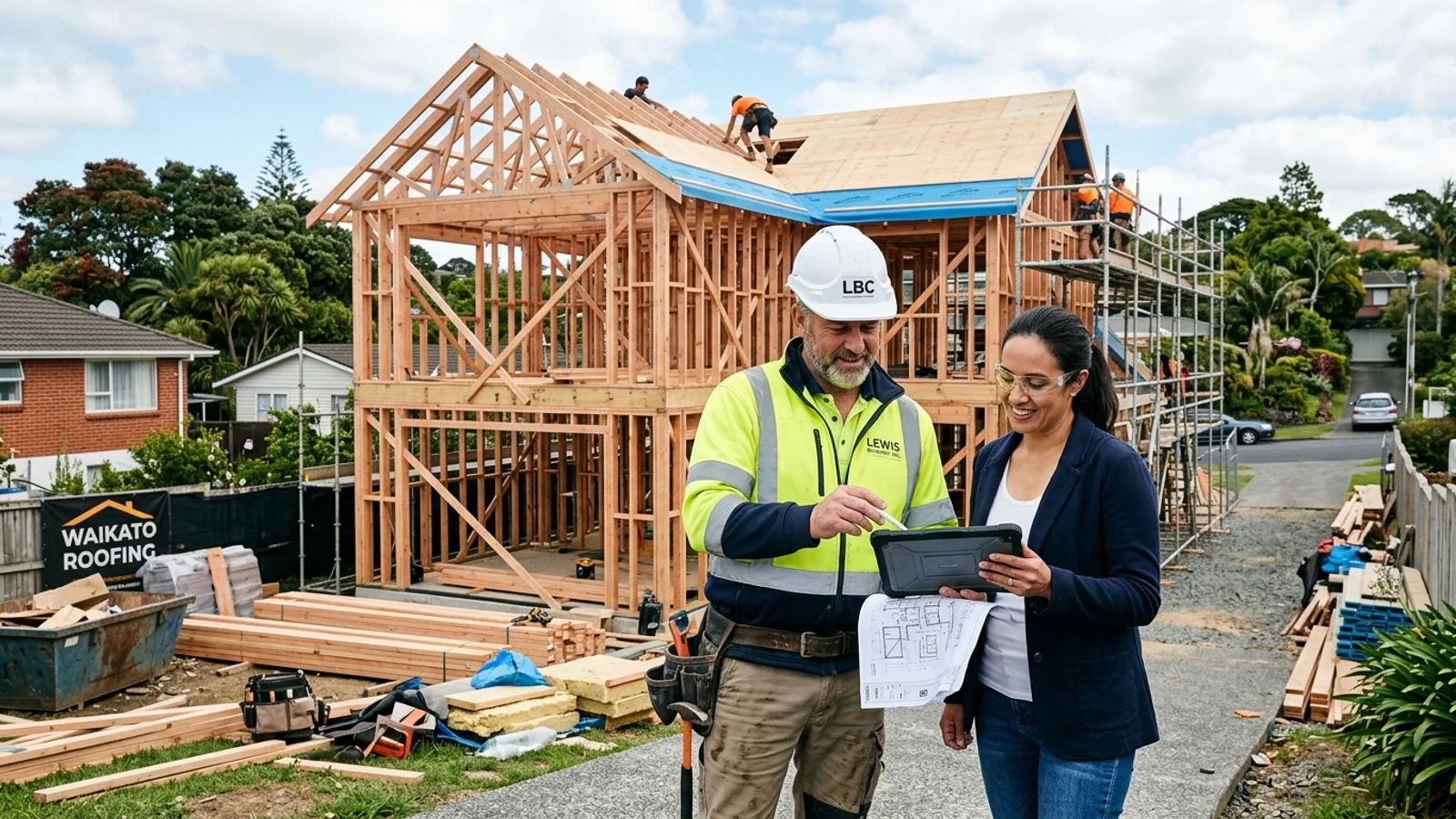
Stage 1: Concrete Slab / Foundation (~20–25%)
Covers earthworks, excavation, drainage prep, under-slab plumbing, steel reinforcing, and concrete pouring. Released once the foundation is poured and council inspection passes.
Stage 2: Timber Framing (~15–20%)
Covers wall framing, roof trusses, floor joists, and structural steel beams. The structure takes its recognizable shape and passes council pre-wrap inspections.
Stage 3: Roof & Lock-Up / Weathertight (~20–25%)
Covers roofing iron/tiles, building wrap, exterior cladding, exterior doors, and double-glazed windows. The home is now secure and weatherproof from New Zealand conditions.
Stage 4: Interior Fit-Out / Fixing (~20–25%)
Covers electrical wiring, plumbing pre-pipe, insulation, plasterboard stopping, interior doors, painting, kitchen cabinetry, and bathroom tiles.
Stage 5: Practical Completion & CCC (~10–15%)
The final retention sum. Released only after all carpets, appliances, driveways, and finishing touches are completed, and the local council issues the official Code Compliance Certificate (CCC).
Valuation Certificates & QS Reports: Getting Funds Released
When your builder finishes a milestone, they issue a progress invoice. However, the bank will not transfer funds to your builder based solely on an invoice email.
To ensure lending security matches real physical progress on site, New Zealand retail banks require independent verification:
- Registered Valuer Progress Inspection: A bank-approved registered valuer visits the property to inspect the completed works, check off materials, and calculate the updated "cost to complete." They issue a formal Progress Valuation Certificate confirming the requested funds match the value added to the site.
- Quantity Surveyor (QS) Drawdown Certificate: For larger architectural builds or multi-unit developments, lenders often appoint a Quantity Surveyor to oversee the entire expenditure schedule and sign off on all progress claims.
- Builder's Risk & Contract Works Insurance: Before the first building drawdown is approved, you must provide proof of comprehensive Contract Works Insurance covering storm damage, fire, and construction site liabilities.
(Yes, the bank really will hold back your final drawdown until the council issues the physical Code Compliance Certificate. No, a letter from the builder saying "it's basically finished" won't convince them.)
Interest-Only Repayments During the Build: What You Actually Pay
One of the biggest financial questions borrowers ask is: "How do I pay rent or my current mortgage while building a new home?"
The advantage of a New Zealand construction loan is that you are charged interest-only on the drawn portion of the facility during construction. You do not pay principal repayments until the home is completed.
Consider a $500,000 build facility alongside a $400,000 section:
- Month 1 (Land Settlement): You pay interest-only on the $400,000 land loan balance.
- Month 3 (Foundation Poured): The bank releases $100,000 for the slab. Your active balance is now $500,000, and interest is calculated on that figure.
- Month 6 (Lock-Up): Framing and roof drawdowns add another $200,000. Your interest is now calculated on $700,000.
- Month 10 (Completion & CCC): The final drawdowns bring the loan to the full $900,000. The facility converts to a standard principal-and-interest mortgage on your chosen fixed or floating rate.
This progressive interest structure keeps your monthly holding costs manageable while you maintain your current living arrangements. You can test various rate scenarios with our mortgage repayment calculator.
The 10%–15% Cost Overrun Contingency Rule
In construction, surprises happen under the ground. Difficult soil conditions, retaining wall redesigns, or upgraded kitchen stone can quickly push costs past initial estimates.
This is the "we're gonna need a bigger boat" moment of a new build — when unexpected ground conditions or variation orders eat through your initial contingency budget.
To prevent uncompleted builds, New Zealand banks enforce a mandatory cost overrun contingency buffer:
- Fixed-Price Master Build Contracts: Typically require a 10% contingency factored into your borrowing capacity.
- Labour-Only or Managed Builds: Lenders view non-fixed contracts with extreme caution and often demand a 15% to 20% contingency in verified cash reserves.
If your fixed-price build contract is $500,000, your adviser will structure your serviceability assessment and total loan approval at $550,000. If you don't use the $50,000 buffer during the build, you simply don't draw it down — leaving your final mortgage balance lower.
Deposit Requirements & Equity for Land & Build Loans
Under Reserve Bank of New Zealand (RBNZ) Loan-to-Value Ratio (LVR) rules, construction lending receives favorable regulatory exemptions designed to encourage new housing supply.
Here is how deposit and equity rules apply across different buyer scenarios:
- Standard Owner-Occupier Build: Minimum 15% to 20% deposit based on the combined on-completion registered valuation (land value + contract cost).
- Using Existing Land Equity: If you already own your section unencumbered (or with a small remaining mortgage), the equity in your land counts directly toward your build deposit. In many cases, you do not need to contribute any additional cash.
- Kāinga Ora First Home Loan: Eligible first home buyers can build a new home with as little as a 5% deposit through participating lenders backed by Kāinga Ora. Learn more in our Kāinga Ora First Home Loan guide.
- Residential Property Investors: While existing rental properties typically require a 35% deposit, new residential construction builds are exempt from high-LVR limits, allowing qualifying investors to build with a 20% deposit.
Practical Completion & Code Compliance Certificate (CCC)
The finish line of the construction loan process is governed by the Building Performance / MBIE regulatory framework.
Before your bank releases the final 10% to 15% retention payment to the builder, four mandatory documents must be delivered to your lawyer and lender:
- Code Compliance Certificate (CCC): Issued by the local city or district council confirming the home complies with the New Zealand Building Code and approved building consent.
- Final Completion Valuation: A registered valuer report confirming the home is fully finished, habitable, and valuing the property at or above initial projections.
- Standard Residential Home & Contents Insurance Policy: Transitioning from Contract Works Insurance to a standard replacement domestic home insurance policy.
- Master Build / Certified Builders 10-Year Guarantee: Handed over and formally transferred into your name.
Once these documents are verified, the construction facility is finalized. You then work with your adviser to split your mortgage into your preferred fixed and floating tranches (see our fixed vs floating home loan guide).
Construction Loan Process Checklist (From Plan to Handover)
Follow this 6-stage roadmap to ensure your finance moves smoothly alongside your build schedule:
- Stage 1: Pre-Approval & Borrowing Capacity. Obtain a formal conditional pre-approval from an adviser before committing to land purchase contracts or non-refundable design deposits.
- Stage 2: Section Purchase & Land Settlement. Settle your section. If you already own land, complete a registered valuation to establish your starting equity.
- Stage 3: Plans, Specs & Builder Contract Review. Finalise your Fixed-Price Master Build contract with detailed schedule of finishes, architectural drawings, and council consent documentation.
- Stage 4: "As-If-Complete" Valuation. A registered valuer appraises the plans and site to provide the bank with an official projected completion value.
- Stage 5: Progressive Drawdowns & Site Inspections. Builder submits staged invoices; valuer conducts site inspections; bank releases funds directly to the builder.
- Stage 6: Final CCC & Loan Conversion. Council issues CCC; final retention is released; your loan converts into a standard long-term mortgage structure.
Explore our full range of new build advisory services on our building my new home page.
FAQs
Straight Answers: Construction Loans in NZ
How do construction loan progress payments work in NZ?
With a progress-payment construction loan, the bank does not release your full loan upfront. Instead, funds are drawn down in staged instalments as each construction milestone (slab, framing, lock-up, interior fit-out, and practical completion) is inspected and completed by your builder.
How much deposit do I need for a construction loan in New Zealand?
Most New Zealand lenders require a minimum 15% to 20% deposit based on the total combined cost of the land plus the build contract. Eligible first home buyers using the Kāinga Ora First Home Loan scheme may be able to secure a construction loan with as little as a 5% deposit on qualifying packages.
Do I pay full mortgage repayments while my house is being built?
No. During the build period, you only pay interest on the money actually drawn down from your loan facility. As each progress stage is paid to the builder, your drawn balance increases, and your monthly interest payment adjusts accordingly until the final Code Compliance Certificate (CCC) is issued.
What is a registered valuer progress drawdown certificate?
Before releasing funds for major construction stages (such as framing, lock-up, and completion), most banks require a Registered Valuer or Quantity Surveyor to visit the building site and issue a Progress Inspection Certificate verifying that the work matches the builder’s invoice and specifications.
Why do banks require a cost overrun contingency budget?
Banks typically require a 10% to 15% cost overrun contingency fund approved in your loan facility (or held in uncommitted cash) to cover unexpected site works, council consent variations, or price adjustments without stalling construction mid-build.
What is the difference between a turnkey contract and a progress payment build?
A turnkey contract requires a 5% to 10% deposit upfront, with the remaining 90% to 95% paid as a lump sum on settlement once the home is fully completed and CCC is issued. A progress-payment build involves buying the section first and paying the builder in staged instalments throughout the construction timeline.
How long does pre-approval take for a construction loan?
Construction loan pre-approvals typically take 3 to 5 business days once your build contract, fixed-price specifications, architectural plans, and financial documents are lodged with an adviser across our panel of 20 bank and non-bank lenders.
Planning to Build in New Zealand?
The right build structure won't find itself. Book a free, no-obligation construction loan consultation with Kundan Singh before you sign your building contract.
- Zero upfront fee for advice — we are typically remunerated directly by the lender upon settlement
- Access to 20 bank and non-bank lenders on our panel (7 banks, 13 non-bank)
- Drawdown alignment — we match your loan terms to your builder’s payment milestones
- Licensed Financial Advice Provider (FSP 714331 / Kundan Singh FSP 512966)
- Fast turnaround — reply within 2 business hours and pre-approvals in 3–5 business days