
Property Buying & Lending Strategy
Buying a House Off the Plans NZ: Finance, Sunset Clauses & Valuation Risks
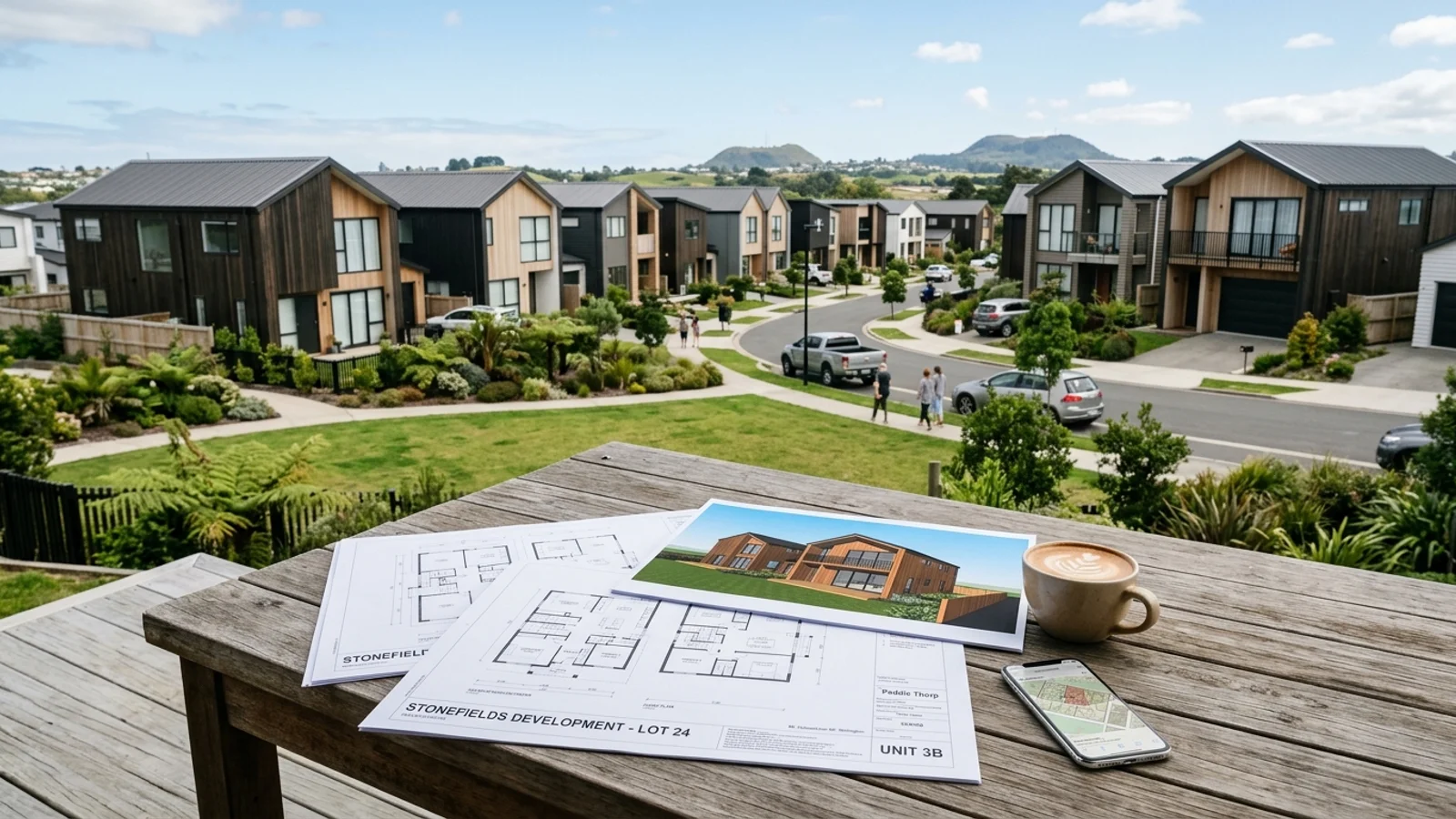
Buying off the plans is the only time you spend hundreds of thousands of dollars on something that currently looks like a patch of dirt and an optimistic 3D render. It's a bit like ordering dinner off a picture menu — you hope the real meal turns up looking just as good, but you want to make sure the kitchen doesn't run out of ingredients halfway through.
The straight answer: buying a house off the plans in NZ allows you to secure a brand-new home at today's fixed price with a 5% to 10% deposit, but your mortgage does not draw down until the build is finished, Code Compliance Certificate (CCC) is granted, and Certificate of Title is issued — usually 12 to 24 months down the track.
That long construction gap creates three distinct financial hurdles that catch unprepared Kiwi buyers out:
- Pre-Approval Expiry: Bank pre-approvals usually expire after 90 days, long before the framing is even completed.
- Valuation Shortfalls: If the local property market dips before completion, the bank lends on the lower valuation, leaving a cash shortfall you must fund yourself.
- Developer Delays & Sunset Clauses: If materials or consent hold-ups push completion past the contract date, poorly drafted sunset clauses can leave your deposit frozen or allow developers to cancel on you.
Here is how off-the-plans finance actually works in New Zealand, how to structure your loan approval across a 12-to-24-month build, how KiwiSaver applies, and the exact due diligence required to protect your deposit.
What Does "Buying Off the Plans" Mean in New Zealand?
When you buy a property off the plans, you sign a legally binding Sale and Purchase Agreement to purchase a home that has not yet been built — or is currently under construction.
You are buying based on architectural plans, engineering specifications, a schedule of finishes, and artistic renders rather than walking through a completed home.
In New Zealand, off-the-plans purchases are common in master-planned subdivisions, standalone housing developments, and multi-unit townhouse projects across Auckland, Waikato, Tauranga, and Canterbury.
Under lending frameworks set by the Reserve Bank of New Zealand (RBNZ), new residential properties purchased directly from a builder or developer enjoy an official LVR exemption. While buying an existing investment property requires a 35% deposit, new builds can often be financed with a 20% deposit for investors, and as little as 10% for owner-occupiers (or 5% under the Kāinga Ora First Home Loan scheme).
However, the transaction structure differs fundamentally from purchasing an existing home. You pay a deposit upfront upon signing, and the remaining 90% to 95% balance is paid on settlement day — which only happens once the home is finished and council sign-offs are complete.
Turnkey Off-the-Plan vs. Progress Payment Construction Loans
Kiwi property buyers frequently confuse an "off-the-plans turnkey build" with a "progress payment construction loan." They are completely different lending products:
| Feature | Off-the-Plans (Turnkey) | Construction Loan (Build Contract) |
|---|---|---|
| Initial Deposit | 5%–10% deposit held in trust | 15%–20% deposit on land and total build cost |
| Land Ownership | Developer owns land during construction | You purchase and own the section first |
| Loan Drawdowns | Single lump-sum drawdown at completion | 5 progressive drawdown stages during the build |
| Interest During Build | No mortgage repayments until settlement | Interest-only repayments on drawn funds as build progresses |
| Cost Overrun Risk | Fixed contract price borne by developer | You need a 10%–15% cost overrun contingency buffer |
If you are looking at building your own custom architectural home with staged builder invoices, read our dedicated construction loan process guide or explore our turnkey home loans advisory service.
The 12-to-24 Month Finance Gap: Pre-Approval Expiry & Re-assessment
Here is the single biggest trap when buying off the plans in New Zealand: standard bank pre-approvals only last 90 days.
If you sign an off-the-plans contract in January with an estimated completion date in December, your initial pre-approval will expire three times over before you ever receive the front door key.
(Yes, the bank's pre-approval letter really did say 90 days. No, they won't automatically honor it two years later just because the framing is up and looking sharp.)

When your development nears completion (typically 60 to 90 days out from Code Compliance Certificate), the bank must re-assess your financial position before issuing unconditional loan documents.
The bank will re-evaluate:
- Your Employment & Income: Verifying your current payslips or latest financial statements.
- Current Interest Rates: If test rates have increased since you signed, your borrowing power may be reduced.
- New Liabilities: Any car loans, buy-now-pay-later accounts, or credit card limit increases taken out during the build.
- Family Changes: Changes in dependants or moving from two full-time incomes to one.
Some New Zealand banks offer extended "turnkey pre-approvals" that can be locked in for up to 12 months with milestone checks, provided your underlying financial circumstances remain unchanged. Working with an adviser who has access to multiple lenders allows you to place your file with a bank that actively supports extended completion timeframes.
The 5%–10% Deposit: Solicitor Trust Accounts & KiwiSaver Rules
When you sign an off-the-plans contract, you are required to pay a deposit once the agreement becomes unconditional (or upon signing). In New Zealand, this deposit is typically 10% of the purchase price, though some developers and Kāinga Ora First Home Loan lenders accept 5%.
1. The Solicitor Trust Account Rule (Non-Negotiable)
Your deposit must always be paid into a solicitor's or licensed real estate stakeholder trust account, where it is held in escrow until the development achieves title and CCC.
Never agree to a contract clause that allows the developer to release your deposit directly into their own operational bank account to fund construction costs. If that developer runs into cashflow trouble or enters receivership, an un-escrowed deposit can be completely lost.
2. Using KiwiSaver for Your Off-the-Plans Deposit
You can use your KiwiSaver first home withdrawal to fund the initial deposit on an off-the-plans property.
Key requirements to keep in mind:
- You must have been a KiwiSaver member for at least 3 years.
- You must leave a minimum balance of $1,000 in your account.
- The funds are paid directly from your KiwiSaver scheme provider to your solicitor's trust account.
- The contract must contain a clause ensuring the funds remain in the solicitor's trust account until settlement day.
For detailed timing rules and statutory declarations, read our step-by-step guide on KiwiSaver first home withdrawals in NZ.
The Valuation Shortfall Risk: "As If Complete" vs. Settlement Day
This is the "we're gonna need a bigger boat" moment of an off-the-plans purchase — the build went smoothly, but the completion registered valuation came back $40,000 below the contract price.
When you sign an off-the-plans contract, the bank assesses the purchase against an "as if complete" valuation. But when the build finishes, the bank requires a final completion inspection or registered valuation before releasing mortgage funds.
New Zealand banks enforce a strict rule: they only lend against the lesser of the contract purchase price or the final registered valuation.
How a Valuation Shortfall Works in Practice
- Contract Purchase Price (signed 18 months ago): $850,000
- Your 10% Deposit Paid into Trust: $85,000
- Expected Loan Amount (90% LVR): $765,000
- Final Registered Valuation at Completion: $800,000 (market correction of $50,000)
- Bank's Maximum 90% Loan against Valuation ($800,000 × 90%): $720,000
- Funding Gap You Must Pay in Cash on Settlement Day: $45,000
If you do not have that extra cash buffer or family equity backing, you risk being unable to settle — and the developer can enforce the contract.
To protect yourself against valuation gaps, maintain a cash reserve during the build, avoid stretching your borrowing capacity to the absolute dollar limit, or structure your deposit with a non-bank alternative if a bank becomes restrictive near completion.
Sunset Clauses: Your Safety Net (and the Developer Cancellation Trap)
A sunset clause is one of the most vital legal clauses in any off-the-plans contract. It establishes a "drop-dead date" (long-stop date) by which the developer must complete the build, secure the Code Compliance Certificate, and issue the Certificate of Title.
If the developer misses the sunset date (e.g., due to supply chain failures, contractor insolvencies, or council zoning hold-ups), the sunset clause gives you the legal right to cancel the contract and retrieve your full deposit from the stakeholder trust account without penalty.
The "Mutual Sunset Clause" Trap
You must have your conveyancing solicitor examine the exact wording of the sunset clause before signing.
Some developer agreements include a mutual sunset clause — giving both the buyer and the developer the right to cancel if the sunset date passes.
In a rising property market, opportunistic developers have used mutual sunset clauses to intentionally drag out construction milestones, trigger the sunset date, cancel the contract, and immediately re-list the finished property on the open market for a higher price.
Your solicitor should negotiate for a purchaser-only sunset clause, ensuring that only you have the discretion to cancel or grant an extension if construction runs overtime. Review official consumer guidance on Settled.govt.nz.
Pre-Settlement Checks: Practical Completion, Titles & CCC
When the developer issues a notice of completion, you typically have between 5 and 10 working days to settle.

Before your solicitor authorizes loan drawdown, three critical milestones must be checked:
- Code Compliance Certificate (CCC): Issued by the local council confirming the building complies with the New Zealand Building Code and resource consent. No bank in NZ will advance mortgage funds without a copy of the CCC.
- Certificate of Title (LINZ): The subdivision must be fully registered with Land Information New Zealand (LINZ) so your bank can register its mortgage security over a distinct title.
- Pre-Settlement Inspection (The Snag List): You have the contractual right to inspect the property with a qualified building inspector. Any unfinished joinery, painting defects, plumbing issues, or non-compliant fixtures must be recorded on a formal defect notice for the builder to remedy under their warranty.
- Certificate of Currency (Insurance): You must arrange full replacement house insurance before settlement day and supply the Certificate of Currency to your lender.
Five Steps to Buying Off the Plans with AML Home Loans
I've done this since 2017, and an off-the-plans build lives or dies on proper timeline management and finance structuring, not just headline interest rates.
Know your deposit and your numbers before the first call. A borrower who can say "I've got a 10% deposit held in a solicitor's trust account, pre-approval lined up with a lender that holds extended turnkey terms, and a 12-month build buffer" gets taken seriously faster than someone who signed a developer contract on a hunch.
Real Auckland Case: The 10-Day CCC Settlement Sprint
A couple in West Auckland signed an off-the-plans townhouse contract with a 14-month build timeline. Their initial pre-approval with their main bank had expired 9 months earlier. When the developer achieved CCC and issued the mandatory 10-day notice to settle, their bank branch told them their underwriting queue would take 15 working days just to re-evaluate their file. Kundan stepped in, packaged their updated financials, and placed the file with a lender on AML's panel who issued unconditional approval in 3 days. The loan settled on time with zero penalty interest.
Pre-Approval
Assess borrowing power with an adviser who can match you with lenders offering extended turnkey terms.
Legal Review
Have your solicitor check the sunset clause, trust account escrow, and developer track record.
Deposit in Trust
Pay your 5%–10% deposit (cash or KiwiSaver) into the stakeholder trust account upon unconditional contract.
Milestone Tracking
Keep income and credit stable throughout construction; refresh finance approvals 60 days before completion.
CCC & Settlement
Complete your snag inspection, confirm insurance, receive CCC sign-off, and draw down your mortgage.
Explore your buying options on our first home buyers page, compare repayments with our mortgage repayment calculator, or talk to our team before signing your contract.
FAQs
Straight Answers: Buying Off the Plans in NZ
How does mortgage pre-approval work when buying off the plans in NZ?
Standard bank pre-approvals are only valid for 90 days. Because an off-the-plans build can take 12 to 24 months, your mortgage adviser will either place you with a lender offering extended 12-month turnkey pre-approvals or manage scheduled re-assessments with your bank before the property reaches Code Compliance Certificate (CCC) and settlement.
Can I use my KiwiSaver to pay the deposit for an off-the-plan purchase?
Yes. You can withdraw your eligible KiwiSaver funds (leaving a minimum $1,000 balance) to pay the initial deposit on an off-the-plans contract once the agreement is unconditional. The funds are paid directly from your KiwiSaver scheme provider into your solicitor's trust account, where they must be held in escrow until settlement.
What is a sunset clause and why is it critical in off-the-plans contracts?
A sunset clause is a contractual condition that sets a long-stop date for the developer to complete the build, issue the Certificate of Title, and obtain the Code Compliance Certificate. If the developer fails to complete by that date, the clause allows you to cancel the contract and receive your full deposit back with accrued interest.
What happens if the property valuation drops before settlement day?
New Zealand banks lend against the lower of the agreed purchase price or the final registered valuation at completion. If property values drop and the completion valuation is lower than your contract price, the bank reduces its loan amount accordingly. You must cover the valuation shortfall in cash from your own funds on settlement day.
Are off-the-plans new builds exempt from RBNZ LVR restrictions in NZ?
Yes. Under Reserve Bank of New Zealand (RBNZ) lending rules, new residential dwellings purchased directly from a developer (including off-the-plans turnkey contracts within 6 months of CCC) are exempt from standard loan-to-value ratio (LVR) caps. This allows qualifying owner-occupiers to borrow with as little as a 10% deposit, and investors with a 20% deposit.
Where is my deposit held during the construction period?
Your deposit should always be held in a solicitor's or licensed real estate stakeholder trust account in escrow until the development is completed, title is created, and CCC is issued. Never release your deposit directly into a developer's operating bank account, as you risk losing your funds if the developer goes into liquidation.
What is the difference between buying off the plans and a construction loan?
Buying off the plans is typically a turnkey contract where you pay a 5% to 10% deposit upfront and pay the entire remaining balance upon completion and settlement. A construction loan is a progress-payment facility where you purchase the section first and draw down loan funds in 5 progressive stages to pay the builder as construction milestones are met.
Buying Off the Plans in New Zealand?
Sorted doesn't happen by accident. Before you sign an off-the-plans contract on a patch of dirt, book a free consultation with Kundan Singh — we will make sure your finance doesn't vanish while the builders are putting up the walls.
- Zero upfront fee for initial advice — we are typically remunerated directly by the lender upon settlement
- Access to 20 bank and non-bank lenders on panel (7 banks, 13 non-bank lenders)
- Extended turnkey finance support — structured approvals for 12-to-24-month build timelines
- Licensed Financial Advice Provider (FSP 714331 / Kundan Singh FSP 512966)
- Rapid response — reply within 2 business hours and pre-approvals in 3–5 business days