
Buying an Apartment NZ Mortgage: Rules, Floor Sizes & Deposits
The Straight Answer on NZ Apartment Mortgages
Buying an apartment in New Zealand should be exciting, but the moment you hand the floor plan to a bank underwriter, things get tight fast—often tighter than my golf swing after six months off the course. When you are buying an apartment nz mortgage lenders do not look at it like a standard three-bedroom weatherboard home in the suburbs. High-street banks judge an apartment on three strict non-negotiables: internal floor area (most insist on 40 to 50 square metres minimum, strictly excluding balconies and car parks), title structure (Stratum in Freehold vs Leasehold), and the financial health of the Body Corporate. If an apartment measures 38 square metres or the building’s maintenance fund has a shortfall, your main bank may demand a 40% to 50% deposit or reject the loan outright. But that does not mean you cannot buy it. With the right lender panel, flexible criteria, and proper contract due diligence, securing an apartment mortgage is completely achievable.
1. The 40–50 Square Metre Rule: Why Banks Care About Floor Size
When you apply for a home loan on a standalone suburban house, the bank looks at your income, your living expenses, and whether the purchase price matches market value. They do not get out a measuring tape to see whether your living room is 14 square metres or 18 square metres.
With apartments, the measuring tape is the first thing that comes out.
New Zealand retail banks enforce rigid minimum floor area policies. Why? Because banks view small units and studio apartments as niche assets that are harder to sell if a borrower defaults. In banking jargon, small apartments have "limited secondary market liquidity."
Here is how retail bank underwriting tiers typically break down across New Zealand:
50+ Square Metres
The golden threshold. Most major banks (ANZ, ASB, BNZ, Westpac) treat these apartments under standard residential lending criteria. Standard 20% deposit applies.
40–49 Square Metres
Lenders require a separate, closed bedroom (not an open-plan studio). Some banks allow an 80% LVR, while others cap lending at 70% or require head-office credit sign-off.
Under 40 Square Metres
Main banks either decline outright or cap maximum lending at 50% to 60% LVR (demanding a 40% to 50% cash deposit). Requires specialized or non-bank lenders.
(Yes, the bank's checklist really does count a 39-square-metre studio as high risk, even if you could buy it twice over on your income.)
2. How Much Deposit Do You Need for an Apartment in NZ?
Your required deposit depends on three moving parts: whether you are moving in yourself, whether the apartment meets bank size minimums, and current Reserve Bank of New Zealand (RBNZ) Loan-to-Value (LVR) restrictions.
Owner-Occupiers (Buying to Live In)
If you are buying a standard apartment (50+ sqm internal area) to live in as your home, the standard benchmark is a 20% deposit (an 80% LVR).
- Can you buy with a 10% deposit? Yes, but it is restricted. Banks have limited "speed-limit allowances" from the Reserve Bank for low-deposit owner-occupiers. If a bank accepts a 10% deposit on an apartment, they will almost always add a Low Equity Margin (LEM)—an interest rate premium of 0.25% to 0.75%—and they will scrutinise the building's maintenance fund far more aggressively.
- Kāinga Ora First Home Loan (5% Deposit): If you are eligible for the Kāinga Ora First Home Loan scheme, you can technically purchase an apartment with as little as a 5% deposit. However, the apartment must still meet the specific lending bank’s security criteria (such as minimum floor area and building remediation sign-off).
Residential Property Investors
If you are purchasing an apartment as a rental investment, RBNZ rules require a 30% deposit (70% LVR) for existing properties. If you are buying a brand-new apartment directly off-the-plans from a developer that qualifies under the new build exemption, lenders can often accept a 20% deposit.
Using KiwiSaver for an Apartment Deposit
You can use your KiwiSaver first-home withdrawal for an apartment deposit just as you would for a house. Both you and your partner can withdraw everything except your initial $1,000 balance, provided you have been enrolled for at least 3 years and intend to live in the property as your primary residence. For a detailed step-by-step breakdown of withdrawal paperwork and timing, read our guide on KiwiSaver first-home withdrawal rules and traps.
3. Title Types Decoded: Freehold, Leasehold & Company Share
When you buy an apartment, you are not just buying four walls. You are buying a legal interest in a shared piece of land and a collective building. In New Zealand, apartments fall into three distinct legal ownership categories, and banks treat them like night and day.
1. Stratum in Freehold (Freehold Unit Title)
This is the gold standard for New Zealand apartments. You own your individual unit outright, along with an undivided shared ownership of the common property (hallways, lifts, exterior structure, land) managed by the Body Corporate under the Unit Titles Act 2010. Every major bank is comfortable lending on Stratum in Freehold, assuming floor size and building maintenance checks pass.
2. Stratum in Leasehold (Leasehold Unit Title)
You own the apartment structure, but someone else (such as a private trust, local iwi, or the Ports of Auckland) owns the underlying land. You pay an annual "ground rent" to the landowner, which is re-negotiated every 5, 7, 10, or 21 years.Bank stance: Banks hate leasehold apartments. When ground rent reviews come up, annual land fees can skyrocket by 200% to 500%, instantly crippling the owner's cash flow. Most retail banks will either refuse to lend or require a massive 40% to 50% deposit, and they insist the remaining lease term extends well beyond your mortgage term (typically 20+ years remaining).
3. Company Share (Company Title)
Common in vintage 1950s–1970s apartment buildings (frequent in Wellington and older Auckland suburbs). You do not own real estate directly; you buy shares in a company that owns the building, which grants you the right to occupy a specific apartment.Bank stance: Because you hold company shares rather than a registered land title, banks cannot easily register a standard mortgage over the property. Most major banks will not lend on company share apartments. Those that do cap borrowing at 65% to 70% LVR and require formal approval from the building's board of directors.
If you are also comparing apartments to units on shared suburban sections, take a look at our companion breakdown on cross-lease property mortgages, flats plans, and defects.
4. The Unit Titles Amendment Act: What Underwriters Inspect
On 9 May 2023, the Unit Titles (Strengthening Body Corporate Governance and Other Matters) Amendment Act 2022 came into full legal force across New Zealand.
This was the biggest overhaul of apartment ownership rules in over a decade. Before this law, vendors could hide messy maintenance issues behind vague summaries. Today, sellers must legally provide an exhaustive Pre-Contract Disclosure Statement (PCDS) before a buyer signs an agreement.
When your mortgage application reaches a bank underwriter, they will not just look at your payslips. Their legal and credit risk teams will demand and comb through the entire disclosure bundle. Here is exactly what they scrutinise:
- 3 Years of Body Corporate Minutes: Underwriters read every page of general meeting and committee meeting minutes from the last 36 months. They look for discussions about leaking windows, cracking concrete, lift breakdowns, acoustic complaints, or disputes between owners.
- 3 Years of Audited Financials: Are owners in the building paying their levies on time? If multiple owners are in arrears, it signals poor management and financial distress in the complex.
- The 30-Year Long-Term Maintenance Plan (LTMP): Large complexes must maintain a rolling 30-year maintenance plan reviewed every three years. The bank checks what capital works are scheduled (e.g. repainting in 2028, roof replacement in 2031) and, crucially, whether the Body Corporate actually has money in the bank to pay for it.
- Mandatory Defect Disclosures: The Amendment Act forces the Body Corporate to disclose any knowledge of weathertightness defects, water ingress, structural issues, or earthquake-prone building status—even if no formal court claim has been filed yet.
5. The Hidden Cost: How Body Corporate Levies Shrink Your Borrowing Power
Many first home buyers look at apartment pricing and think: "A three-bedroom house is $900,000, but a great two-bedroom apartment is $600,000. My mortgage repayments will be tiny."
Then they forget about Body Corporate levies.
Body Corporate fees cover essential building operating expenses: building insurance, common area electricity, lift maintenance, rubbish collection, cleaning, management fees, and contributions to the long-term maintenance fund. In Auckland and Wellington, annual levies for a modern two-bedroom apartment typically range from $4,500 to $9,000 per year (and significantly higher if the complex includes swimming pools, gym facilities, or 24/7 concierge security).
Here is why this matters for your home loan: banks treat Body Corporate levies as an unyielding fixed expense in their mortgage affordability calculators.
How Levies Impact Servicing: The Real Math
Suppose you earn $110,000 and are tested by a bank at an 8.0% stress interest rate.
Before you fall in love with an apartment because the purchase price looks cheap, always calculate your repayments including the exact annual levy using our free mortgage repayment calculator.
6. Red Flags That Trigger Immediate Declines (And Real Solutions)
I've been arranging mortgages since 2017, and bank underwriters can still find creative ways to say no to a solid city pad. In my experience, apartment mortgage declines almost never come down to whether the buyer has a job or can afford the payments. They happen because the building trips a bank credit policy wire.
Here are the four biggest apartment red flags that cause high-street banks to slam the brakes:
1. Active or Unresolved Weathertightness Issues
If the AGM minutes mention intrusive cladding testing, moisture ingress in balcony junctions, or discussions about joining a legal class action against builders or council, major banks will instantly decline finance. Banks will not lend on a building with active leaky-building litigation until a full repair scheme has been priced, agreed, and funded by owners.
2. Unfunded Special Levies
If the Body Corporate has agreed to a $2 million facade maintenance project but only has $150,000 in the reserve fund, each unit owner is facing an imminent "special levy" of $20,000 to $60,000. Unless the vendor pays this levy in full before settlement, banks will either decline your loan or deduct the full levy amount directly from your mortgage borrowing limit.
3. Low Earthquake NBS Ratings (Below 34% or 67%)
In Wellington and older Auckland building zones, banks strictly check the building's New Building Standard (NBS) seismic rating. Buildings rated below 34% NBS are legally classified as "earthquake-prone." Main banks generally refuse to lend on buildings under 34% NBS and apply strict restrictions to buildings between 34% and 67% NBS due to sky-high insurance premiums and mandatory council strengthening notices.
4. High Investor Concentration or Serviced Hotel Pools
If an apartment complex is predominantly short-stay tourist rentals, student accommodation, or tied into a commercial hotel management lease (where you cannot live in your own unit year-round), banks will not classify it as residential property. They will treat it as a commercial hospitality investment, requiring 40% to 50% equity and commercial interest rates.
7. The Non-Bank Advantage: When Main Banks Say No to Your Floor Plan
Here is the core truth about retail banks in New Zealand:Banks decline good home loan applications on policy checklists, not merit. A deal gets a "no" because it doesn't fit a standardised box—like a 38-square-metre floor plate or an older unit title with deferred maintenance—not because the numbers don't work. Commonsense underwriting can still get it funded elsewhere.
At AML Home Loans, we have 20 banks and non-bank lenders on our panel (7 registered retail banks and 13 non-bank and specialist institutions). That breadth makes a massive difference when dealing with apartments.
Real Deal: The 39-Square-Metre Auckland Decline
Recently, a young professional couple came to us after their primary bank declined their mortgage. They had found a modern, beautifully finished city-fringe apartment in Auckland for $520,000. Both were full-time PAYE earners with a combined income of over $130,000, clean bank statements, and a solid 20% cash deposit ($104,000).
Their bank turned them down within 48 hours. Why? The internal floor area measured 39 square metres—exactly one square metre below that bank's rigid 40 sqm underwriting threshold. The branch loan officer told them there was "no discretion" available.
We took the file, reviewed the Body Corporate disclosure documents (which were clean with zero weathertightness history), and placed the application with a specialist lender on our panel whose credit criteria accommodates self-contained one-bedroom apartments down to 35 square metres. We secured conditional approval within 3 business days, and the couple went unconditional before their finance deadline expired. The deal was always fundable. The first bank's automated box was the only roadblock.
If your application does not fit the rigid boxes of high-street banks, check out our guide on how non-bank home loan lenders work in NZ.
8. 5-Step Apartment Buying & Mortgage Due Diligence Checklist
Never sign an unconditional contract on an apartment without working through these five critical steps:
Verify Net Internal Floor Area First
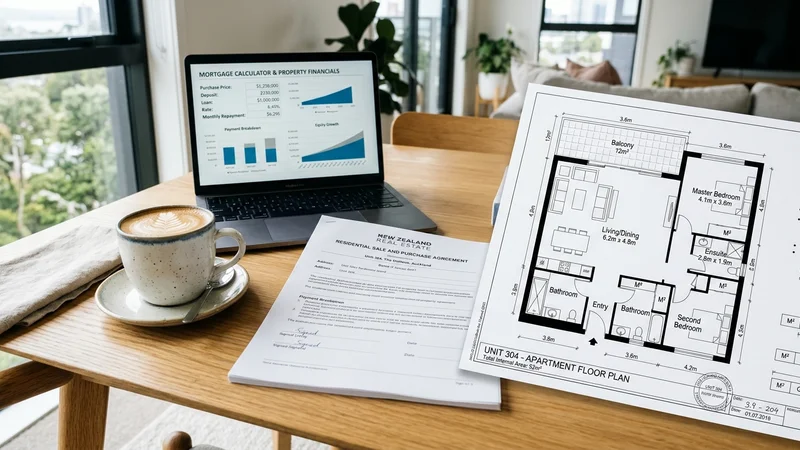
Ask the agent for the deposited plan or architectural floor plan showing internal measurements excluding the balcony and car park. Confirm your exact square metre tier before applying for a loan.
Insert a Specific "Subject to Finance & Body Corp" Clause
Ensure your Sale and Purchase agreement includes at least 10 to 15 working days for finance and full solicitor review of all Pre-Contract Disclosure documents. Never rely on a generic 5-day clause when buying a unit title.
Have Your Lawyer Comb the Body Corporate Records
Your conveyancing solicitor must review 3 years of AGM/EGM minutes, the insurance certificate of currency, the LTMP funding status, and confirm whether any legal claims or levy arrears exist.
Factor the Exact Annual Levy into Bank Servicing
Confirm the current annual levy and any scheduled future increases. Work with an adviser to run the figures through lender servicing calculators to ensure the levy does not derail your borrowing capacity.
Work With an Adviser Who Knows Apartment Criteria
Walking into a single retail bank branch exposes you to one rigid policy. A licensed mortgage adviser can pre-screen your building across multiple lenders to target institutions that actively welcome apartment lending.
For more essential checks before buying your first property, read our guide on 5 things first home buyers must check before going unconditional.
Straight Answers
Frequently Asked Questions About NZ Apartment Mortgages
What is the minimum floor size for a bank home loan on an apartment in NZ?
Most major New Zealand banks require an internal floor area of at least 40 to 50 square metres (excluding balconies, car parks, and storage lockers) for standard 20% deposit lending. For apartments between 35 and 40 sqm, banks either demand larger 30% to 50% deposits or decline. For studio units under 35 sqm, non-bank lenders are often required.
How much deposit do I need to buy an apartment in New Zealand?
For standard apartments (50+ sqm), owner-occupiers typically need a 20% deposit (80% LVR). First home buyers using the Kāinga Ora First Home Loan scheme may qualify with as little as 5% deposit if the building meets panel criteria. Residential property investors require a 30% deposit under RBNZ LVR rules for existing apartments.
Can I use KiwiSaver to buy an apartment in NZ?
Yes. You can withdraw your KiwiSaver savings to buy an apartment as long as it is your first residential property, you have been a contributing member for at least 3 years, and you intend to live in the apartment as your primary residence for at least six months. You must retain at least $1,000 in your account.
Why do banks check Body Corporate minutes and the Long-Term Maintenance Plan?
Under the Unit Titles Amendment Act 2022, banks inspect 3 years of AGM minutes, financial audits, and the 30-year Long-Term Maintenance Plan (LTMP). They are checking for active weathertightness defects, un-remediated seismic issues, legal disputes, unpaid levies by other owners, and whether upcoming capital works have sufficient funds in the reserve.
Can you get a bank mortgage on a leasehold apartment in Auckland?
Lending on leasehold apartments is very difficult at main banks. Because ground rent ratchets upward at scheduled review dates (every 5 to 21 years) and the land is owned by a third party, major banks either reject leasehold security or demand a 40% to 50% cash deposit. Stratum in Freehold (freehold unit title) is vastly preferred.
How do Body Corporate levies affect how much I can borrow?
Banks treat annual Body Corporate levies as an unyielding fixed household expense in their serviceability stress-tests. A $6,000 annual levy ($500 per month) reduces your borrowing capacity by roughly $30,000 to $50,000 compared to buying a property with zero ongoing corporate fees.
Sorted Doesn't Happen by Accident
Buying an apartment is one of the smartest ways to step onto the New Zealand property ladder, especially in Auckland and Wellington. But when bank underwriters see a unit title, they reach for a checklist of floor sizes, body corporate minutes, and maintenance funds. If your bank’s algorithm told you your dream apartment is one square metre too small, don't ask the same bank twice. Give us a call at AML Home Loans—we'll place your application with a lender who understands the building.
Found an Apartment You Love? Let's Get the Finance Sorted.
We compare lending policies across 20 bank and non-bank lenders to find the approval that fits your building.
- Free, no-obligation consultation
- Access to multiple banks and lenders
- Licensed Financial Advice Provider (FSP 714331)